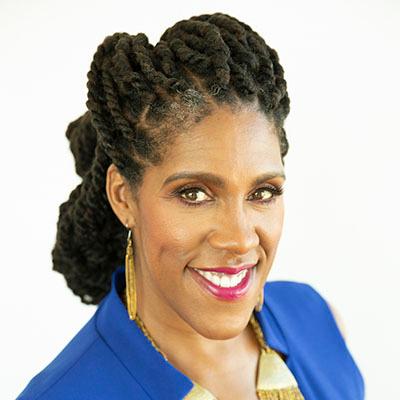
Leadership is about creating space for others and for ourselves
Ms. Foundation for Women’s Teresa C. Younger shares what leadership means in feminist philanthropy and why it comes down to creating space for others and ourselves.

When I stepped into the role of President and CEO of the Ms. Foundation for Women 12 years ago, I thought I understood leadership. I’d led organizations before, I was committed to justice, and I believed fiercely in the power of movements. But this role—leading the nation’s oldest women’s foundation through institutional transformation, cultural upheaval, political whiplash, a pandemic, and a fundamental recalibration of feminist philanthropy—reshaped me in ways I never anticipated.
Leading by making space and listening deeply
What I know now is this: leadership is the art of creating space. Space for people to be seen. Space for ideas to breathe. Space for joy, grief, curiosity, conflict, and rest. And perhaps most importantly, space for ourselves—to pause, to imagine, to evolve.
One of my first decisions as CEO was to get on the road. I traveled across the country meeting with grantee partners, community leaders, movement elders, and young organizers pushing feminism into its next chapter by redefining feminism to be more inclusive and break out the gender binary. I asked questions. I sat in living rooms and community centers. I listened—not as a CEO, but as a learner.
Those conversations became the foundation for Ms. Foundation’s strategic framework that centered women and girls of color as a point of inclusion, not exclusion. The language in the strategic framework is intentional and explicit in naming the importance of supporting leaders of color to advance democracy. It named a truth philanthropy had long ignored: Women and girls of color have always carried movement work, often without recognition or investment. Our framework challenged those of us in philanthropy to see our own blind spots and to acknowledge that if women and girls of color are not at the center of our work, then equity is not at the center of our work.
Holding power responsibly, intentionally, and unapologetically
I have spent my entire career navigating the complicated relationship between philanthropy and movements. Philanthropy is often uncomfortable naming its power, yet movements feel its weight every single day. I often sit with the question of how we build assets and power when only about 2% of philanthropic giving goes to women and girls overall, peaking at 2.18% in 2022. When we released the first Pocket Change: How Women and Girls of Color Do More with Less report, we put data to what I had known for years: women and gender-expansive leaders of color receive a devastating 0.05% of philanthropic dollars.
Power imbalances don’t disappear because we are well intentioned. But power itself is not the enemy. Feminist leadership demands that we hold power responsibly, share it intentionally, and use it unapologetically to shift resources toward sustainable assets and the people advancing justice on the ground. Sitting at the table is not a compromise; it is a responsibility.
Staying grounded through upheaval and prioritizing rest
During my tenure, I have briefed White House leaders on gender equity strategies—only to watch, months later, fundamental rights erased with the stroke of a pen. I have celebrated movement wins one day and fielded crisis calls from grantee partners and staff the next. Leadership in this era requires moving through constant whiplash without losing your grounding. It requires being both visionary and steady, hopeful and honest. And it requires choosing—every day—to show up.
One of the hardest lessons I’ve learned is that rest is essential to the work. Our foremothers fought, marched, strategized, and sacrificed, often without the space for or privilege of rest. I have learned, sometimes the hard way, that exhaustion distorts reality.
I don’t rest easily, but I know rest brings clarity. It allows us to return to the work grounded and able to see possibilities we missed before. Rest is not a reward for finishing the work. It is the fuel required to sustain it.
Holding close what truly matters in leadership
As I step into my next chapter—what I call “Project Stargazing”—I’ve been reflecting on what I hope the next line of leaders hold close:
Pace yourself. The backlash of this moment is fierce because the progress has been real. This is a marathon, not a sprint. Move at a pace that protects your dignity, integrity, and clarity. Don’t be distracted by voices insisting you are not doing enough—you are.
Lead with abundance. We can list every barrier in our path, but we must also name our wins. Celebrate every victory, every step, even the smallest. Each one moves us closer to collective liberation.
Build community intentionally. Know who sits at your kitchen table. Who grounds you? Who tells you the truth? Who makes you laugh? And, perhaps most importantly, who do you listen to? This work is far too heavy to carry alone.
Stay rooted in shared values, not just shared language. Not everyone will claim the word “feminist.” Not everyone will use the language of gender equity. That’s okay. If someone believes in the social, political, and economic equality of all genders, you share a foundation.
Keep imagining. We are in a moment where we can reenvision everything—how we define gender, structure care, build safety, and expand opportunity. Imagination is power, and insisting on something better is a political act.
Creating space for what’s possible
My greatest hope is that we continue to create space—for each other and for ourselves. Space to lead. Space to evolve. Space to rest. And space to dream the world we deserve into existence.
Because ultimately, leadership is not about what we hold. It’s about what we make possible.
Photo credit: New Hampshire Women’s Foundation
About the authors